
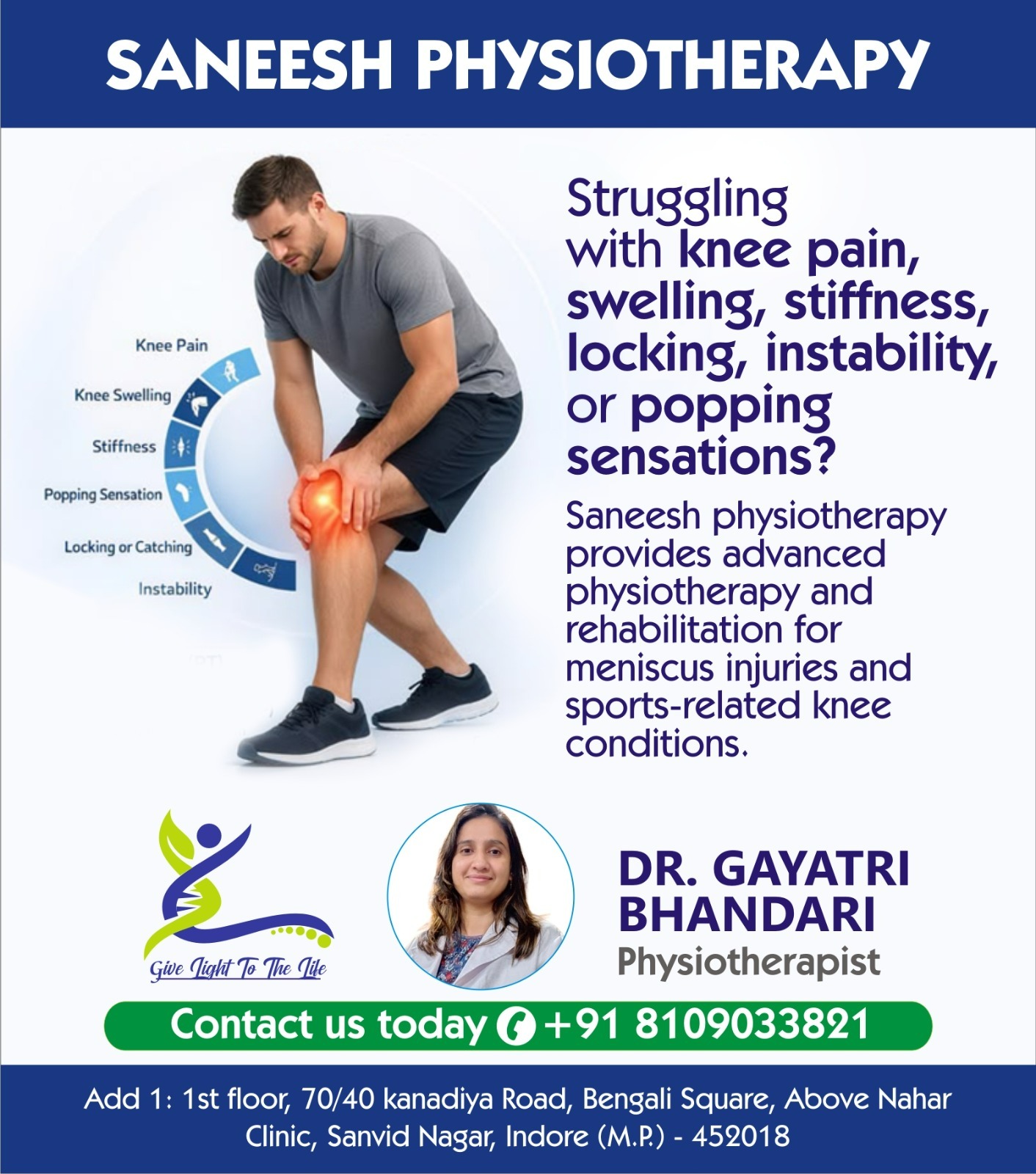
Meniscus Injury and Knee Pain Physiotherapy in Indore
Knee pain can interfere with walking, climbing stairs, exercising, working, and even sitting comfortably for long periods. While occasional soreness may improve with rest, persistent pain, swelling, weakness, catching, or instability can indicate an underlying knee problem that needs professional evaluation. Meniscus injuries are among the common causes of these symptoms, particularly in athletes, active adults, and people who perform frequent twisting or squatting movements.
Professional knee pain physiotherapy in Indore can help identify movement limitations, reduce discomfort, rebuild strength, and improve confidence during daily activities. At Saneesh Physiotherapy and Rehabilitation Centre – Dr. Gayatri Bhandari, rehabilitation is planned according to the patient’s symptoms, injury severity, activity level, physical condition, and recovery goals.
The meniscus is a firm, flexible cartilage structure located between the thigh bone and shin bone. Each knee has two menisci—one on the inner side and another on the outer side.
The meniscus performs several important functions:
A sudden twist, forceful turn, deep squat, sports collision, or awkward landing may damage the meniscus. Degenerative changes can also weaken the tissue over time, making it more vulnerable to injury during ordinary movements.
Symptoms may begin immediately after an injury or develop gradually over several hours. Some people can continue walking initially, but pain and stiffness often increase later.
Common signs include:
A clicking sound alone does not always indicate serious damage. However, clicking accompanied by pain, swelling, locking, or instability should be assessed by a qualified professional.
Meniscus injuries can affect people of different ages and activity levels.
Football, basketball, badminton, cricket, running, tennis, and other sports involving rapid direction changes may increase the likelihood of twisting injuries.
Incorrect squatting, heavy lifting, sudden rotation, poor landing mechanics, or excessive training can place additional strain on the knee.
As cartilage changes with age, a minor movement may be enough to cause symptoms. Degenerative meniscus problems may occur without a major accident.
Past ligament, cartilage, or joint injuries may change movement patterns and increase stress on certain parts of the knee.
Weakness in the thigh, hip, calf, and core muscles can reduce knee control and increase load during daily or sporting activities.
Seek physiotherapy for knee pain in Indore when discomfort lasts for more than a few days, swelling returns repeatedly, or the knee feels unstable.
Professional evaluation is particularly important when:
Immediate medical evaluation is necessary after a major accident, severe swelling, visible deformity, inability to bear weight, fever with a hot swollen knee, or sudden calf pain.
The purpose of physiotherapy is not limited to reducing pain. It also focuses on restoring normal movement, strength, balance, coordination, and functional performance.
A structured meniscus injury rehabilitation programme in Indore may include the following stages.
The physiotherapist may examine:
This assessment helps determine whether conservative rehabilitation is appropriate or whether further medical investigation is needed.
Early rehabilitation may focus on controlling irritation and protecting the knee from unnecessary stress.
Depending on the condition, management may include:
Complete inactivity is not always necessary. Carefully selected movement can help maintain circulation, reduce stiffness, and support recovery.
Pain and swelling may reduce the ability to bend or straighten the knee. Gentle exercises are introduced progressively to restore comfortable movement without increasing symptoms.
Mobility work may focus on:
Regaining knee extension is particularly important for normal walking and standing posture.
The quadriceps, hamstrings, gluteal muscles, calves, and core all contribute to knee control. Weakness in these areas may increase stress on the injured structure.
A personalised strengthening programme may include:
Exercise intensity should increase gradually according to pain, swelling, control, and recovery progress.
After a knee injury, the joint may feel uncertain even when pain has reduced. Balance exercises help retrain the body’s awareness of joint position and improve movement control.
Rehabilitation may progress from stable two-leg tasks to:
These exercises are especially important for patients returning to running or sports.
Poor alignment during walking, squatting, jumping, or climbing stairs can place repeated stress on the knee. Physiotherapy helps identify and correct these patterns.
The patient may be guided on:
Improving technique can reduce recurring irritation and support long-term joint protection.
No. Many meniscus-related problems can be managed without surgery, depending on the tear type, location, age, symptoms, activity demands, and overall knee condition.
Conservative treatment may be considered when:
Surgery may be considered when mechanical locking persists, the tear is unstable, symptoms remain severe despite appropriate treatment, or associated ligament injuries are present. The decision should be made after clinical assessment and relevant investigations.
Physiotherapy is valuable whether treatment is conservative or surgical. It may help before surgery to improve strength and after surgery to support safe recovery.
After meniscus repair or another knee procedure, rehabilitation usually follows specific precautions. The programme may differ depending on whether the meniscus was repaired or partially removed.
Post-operative knee physiotherapy in Indore may focus on:
Patients should follow their surgeon’s restrictions regarding weight-bearing, knee bending, brace use, and return to activity.
Recovery time varies considerably. A mild irritation may improve within a few weeks, whereas a complex injury or surgical repair may require several months.
Progress depends on:
Rehabilitation should be based on functional progress rather than a fixed deadline. Returning to demanding activity too early may increase the risk of reinjury.
During the painful phase, avoid movements that repeatedly aggravate symptoms.
These may include:
The objective is not to avoid movement permanently. It is to reduce irritating activities temporarily and reintroduce them safely as control improves.
A general internet exercise programme may not suit every knee condition. An exercise that benefits one person may worsen another person’s symptoms if the diagnosis, strength, movement pattern, or injury stage is different.
Personalised knee rehabilitation in Indore offers several benefits:
At Saneesh Physiotherapy and Rehabilitation Centre – Dr. Gayatri Bhandari, the aim is to help patients regain comfortable movement through structured, practical, and goal-oriented care.
Many meniscus problems respond to activity modification, mobility exercises, strengthening, and progressive rehabilitation. The result depends on the injury type, severity, locking symptoms, and overall condition of the knee.
Gentle walking may be acceptable when it does not increase pain, swelling, or instability. Long-distance walking, rapid turning, and uneven surfaces may need to be limited during the early recovery stage.
Clicking may occur because of joint movement, tendon motion, cartilage changes, or a meniscus problem. Painless clicking is often less concerning, but clicking with swelling, locking, or instability requires assessment.
Return to sports should occur only after adequate strength, mobility, balance, confidence, and movement control have been restored. The timeline varies according to the injury and treatment method.
Do not allow recurring knee pain, swelling, catching, or weakness to limit your daily routine. Early assessment can identify the likely cause and help you begin a safer recovery plan.
Call +91 8109033821 to book an appointment at 1st Floor, 70/40 Kanadiya Road, Bengali Square, above Nahar Clinic, Sanvid Nagar, Indore, Madhya Pradesh – 452018.
Contact Us today and begin personalised physiotherapy for stronger movement, improved stability, and greater confidence in your knee.
| Tags: | #Meniscus Injury and Knee Pain Physiotherapy in Indore |


