
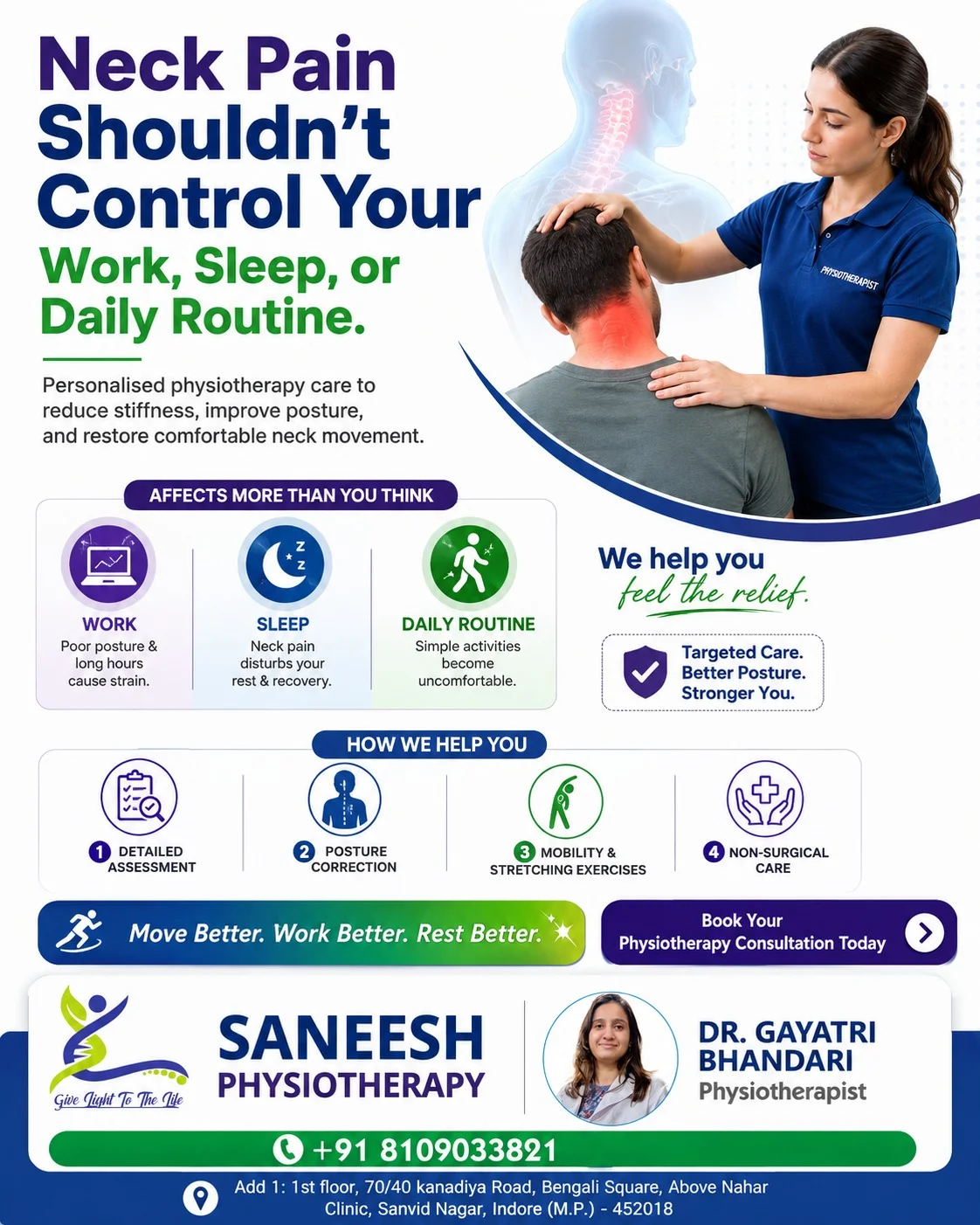
Neck Pain Physiotherapy Treatment in Indore
Neck pain can affect much more than just the ability to turn your head. Chronic stiffness or pain can interfere with working at the computer, concentrating for long hours in the office, sleeping comfortably, driving, exercising or doing normal daily activities. If you are looking for Neck Pain Physiotherapy Treatment in Indore, a systematic physiotherapy assessment can help in identifying movement limitations, muscle weakness, posture related factors and other likely contributors to the issue.
Saneesh Physiotherapy, Indore offers personalized physiotherapy care by Dr. Gayatri Bhandari. It is a holistic method that includes proper assessment, posture correction, mobility improvement, stretching, strengthening and non-surgical treatments tailored to suit individual requirements.
Neck pain is pain in the cervical spine, located between the skull and the upper part of the thoracic spine.
Neck pain is pain felt in the area of the cervical spine, muscles, joints, ligaments, disks or other related structures. You may feel a dull ache, stiffness, tightness, sharp pain or limited range of motion.
For some people the pain is limited to the neck, while in others the pain radiates into the shoulder or arm. It can also cause tingling or numbness when a nerve is irritated.
Depending on the cause, neck pain may come on suddenly or gradually.
The cervical spine supports the head , allows movement of the head , and protects critical nerves and the spinal cord . Because we use our necks for so many routine activities, pain or stiffness can interfere with our daily lives.
Some of the common issues may be:
• Working long hours at a desk • Staring at a laptop or mobile phone
• Driving with a guilty conscience
• Finding a comfortable sleeping position
• Workout
• Household chores
• Survive long meetings
• Handbag
• Upward or downward
• Keep your eyes on the ball while you work
This is why Physiotherapy for Neck Pain in Indore usually tries to focus not only on symptoms but also on restoring comfortable movement and function.
There are many causes of neck discomfort. The physiotherapist will take a history and then assess the movement pattern before deciding on a treatment plan.
Prolonged static positioning can lead to muscle fatigue and discomfort, especially when workstation setup or movement habits are poor.
An awkward twist, unusual exercise, repetitive motion or prolonged positioning can stress muscles around the neck and shoulders.
With age changes, sometimes the cervical spine is affected and it can stiffen or become painful. Conservative treatment may include physical therapy that involves posture work, mobility exercises, strengthening and, when clinically indicated, traction.
Irritation or compression of a cervical nerve can cause pain to radiate from the neck into the shoulder or arm, sometimes with tingling, numbness or weakness.
Specific physiotherapy exercises can help to improve motion and strength when appropriate.
Cervical pain can also be due to falls, sports injuries, road accidents or rapid neck movements and should be evaluated accordingly.
When symptoms start affecting work, sleep or mobility, People often look for a Neck Pain Physiotherapist near me in Indore.
Symptoms can include:
• Stiff neck • Pain on turning the head
• Taut shoulder muscles
• Limited neck movement
• Pain which radiates into the shoulder
• Headache with neckache
• Pain from overusing the computer
• Struggles to find a comfortable sleeping position
• Numbness or tingling in arm or hand
• Tingling
• Weakness of the muscles
• Recurrent episodes of neck pain
If you experience pins and needles, cold arm or persistent symptoms, then it’s time to seek a professional medical assessment rather than ignoring the problem.
Professional Neck Pain Physiotherapy in Indore starts with understanding the reason behind pain or restriction in movement.
Rather than recommending extended rest, physical therapists sometimes prescribe personalized movements and exercises to help lessen stiffness, regain movement, and keep people active, the American Physical Therapy Association says.
The rehabilitation plan can be directed to several fields.
Before starting treatment the physiotherapist may assess:• Neck mobility
• Mobility of shoulder
• Body Position
• Strength of muscle
• Flexibility of muscles
• Day to day activities
• Work ethics
• Movements that cause pain
• Neurological symptoms if applicable
• Prior injuries
This aids in creating a plan that is tailored to the actual functional limitations of the patient, as opposed to using the same exercises for all.
Postural issues may be one of many sources of neck pain, but it can be useful to look at how someone sits, works, drives or uses digital devices.
A physiotherapist may recommend practical changes to:
• Screen position • Desk setup
• Seated posture
• Position of keyboard and mouse
• frequent breaks from movement
• Positions in sleep
• Repetitive work routines
It is not to be in one so-called “perfect” position all day. That said, it’s usually more practical to aim for regular movement and avoiding long uncomfortable positions.
People can move their neck less when they experience pain and stiffness, which can sometimes lead to further restriction.
Neck Mobility Exercise Program Indore can be tailored to suit you and may include gentle movements to help improve comfortable range of motion over time.
Neck Pain Physical Therapy . Common recommendations for physical therapy for neck pain include simple movements to reduce stiffness and restore normal neck motion .
Exercises need to be chosen according to the individual’s condition and not just randomly copied from videos online.
For some patients, it may be beneficial to build up the strength and endurance of the muscles around the neck, shoulders and upper back.
Exercises in a program may be targeted at:
• Deep neck muscles • Shoulder blades
Muscles of the upper back
• Stabilizers of shoulder
• Postural tolerance
If you have cervical radiculopathy, certain exercises can help relieve pain, strengthen your neck and increase your range of motion.
Physiotherapy may also include hands-on techniques to improve mobility and reduce discomfort, depending on the assessment.
Manual therapy should be used selectively and in conjunction with an active rehabilitation plan, not as a quick fix.
Many people worry that constant neck pain automatically means surgery will be needed. Not necessarily.
Conservative treatment like physiotherapy may be appropriate for several mechanical neck conditions and some cases of cervical radiculopathy before surgery is considered. AAOS cites physical therapy as a nonsurgical treatment for cervical radiculopathy.
Non-surgical physiotherapy care does not mean that every neck condition can be or should be managed without medical or surgical assessment.
The right approach depends on:
• Reason for pain • Earnestness
• Neurological examination
• Duration
• Previous injuries
• Appropriate imaging findings
• Reaction to conservative treatment
Refer patients for further medical assessment where symptoms indicate a condition outside the scope of routine musculoskeletal care.
People who are on laptops or desktops for long hours often experience neck and upper-back pain.
A practical program rather than telling someone to “sit straight” might consider:
• Monitor is too low • Length of time the person is seated
• Change position often
• Strength in the shoulder and upper back
• Range of Neck Motion
• Volume of work and repetitive work
Instead of trying to maintain one rigid posture throughout the day, it may be more realistic to have short movement breaks.
Pain can make it hard to fall asleep or to feel good all nite. Poor sleep can also make you more sensitive to pain the next day.
Depending on your symptoms, the physiotherapist might talk about ways to position and move that feel comfortable for you.
There is no one pillow, or sleeping position, that is a guarantyd remedy for all neck pain. How much is comfortable depends on the person and on what is underlying.
Movement does not usually need to be completely avoided for many simple musculoskeletal neck problems. Physiotherapy advice usually recommends staying active but avoiding activities known to worsen your symptoms.
The choice of exercises should be based on:
• Severity of pain • Identify
• Tolerancia al movimiento
• Neurological symptoms evident
• Recent trauma
• Present Illness History
Stop and seek professional assessment if exercise causes increasing numbness, weakness, severe dizziness or a significant worsening of symptoms in your arms.
Most neck pain is not caused by a serious condition, but certain symptoms need timely medical evaluation.
If neck pain is accompanied by: Seek medical care if
• Significant trauma • Progressive weakness of the arm or hand
• Persistent numbness
• Difficulty walking or maintaining balance
• Bleeding or blood in the urine or stool
•Severe headache of unknown origin
• Marked rigidity of the neck with fever
• Symptoms that persist and are not improving
These symptoms are not just to be treated with exercises at home.
The first appointment for Neck Pain Physiotherapy Treatment in Indore generally starts with a conversation instead of straightaway starting the exercises.
The physiotherapist might ask you:
• When did the pain start? • Where do you feel it exactly? • Does it extend to your shoulder or arm? • To make it worse? • Will it impact sleep? • What do you do for work? • Have you suffered an injury? • Do you have numbness or tingling? • Have you been treated in the past?
“And then we can assess mobility and strength and make recommendations.
Neck pain is different for each patient.
Personalized rehabilitation allows to tailor treatment according to:
• Age • • Activity Level
• Job requirements • Symptomology • Operational goals
• Restrictions on movement
• Recovery progress
For one person, the priority may be to get back to the desk in comfort. Another person may want to return to gym training, driving, household activities or sports.
A treatment plan should incorporate these individual goals.
Certain habits may help reduce unnecessary strain, along with professional treatment:Change position regularly while you are working.
• Take short movement breaks during long sitting times. • Provide quick access to screens used frequently. • Don't cradle a phone between your neck and shoulder. • Gradually increase your neck and shoulder strength. • Be active in general. • Do not forcefully and suddenly manipulate the neck on yourself. • Do the exercises recommended for your condition.
These measures are most useful when they are integrated consistently, not just when the pain is severe.
Primary Keywords for this Topic: Neck Pain Physiotherapy Treatment in Indore, Neck Pain Physiotherapy in Indore, Neck Pain Physiotherapist near me in Indore, Physiotherapy for Neck Pain in Indore, Neck Pain Treatment Without Surgery in Indore, Cervical Pain Physiotherapy in Indore
These terms are representative of common local searches made by people with stiffness, limited mobility, postural problems, cervical pain or arm symptoms related to the neck.
Physiotherapy can help with many musculoskeletal neck problems with appropriate techniques such as tailored exercise, mobility work, strengthening, education and other appropriate techniques. Treatment depends upon the underlying cause.
A lot of neck problems are treated first with conservative methods, and physical therapy can be a part of nonsurgical treatment. Surgery is only considered in certain conditions and is based on symptoms, neurological findings and specialist assessment
Prolonged positions and factors related to the workstation can cause or aggravate discomfort in some people. Regular movement, proper workstation setup and customized exercises can manage these factors.
Consider assessment if pain or stiffness recurs, affects work or sleep, limits movement or does not improve. Persistent tingling, numbness or weakness are other symptoms that should be evaluated clinically.
Don’t let neck pain continually disrupt your work, sleep, mobility, and daily activities. A complete physiotherapy assessment may help to identify movement problems and offer a structured program of postural advice, mobility exercises, strengthening and progressive rehabilitation.
If you are looking for customized Neck Pain Physiotherapy Treatment in Indore, then Saneesh Physiotherapy offers physiotherapy consultation with Dr. Gayatri Bhandari for neck pain, stiffness, posture related issues, and functional rehabilitation.
Schedule your physiotherapy consultation in Indore now. Get in touch with us today and work toward a more comfortable neck movement, better function and an easier daily routine.
| Tags: | #Neck Pain Physiotherapy Treatment in Indore |


